Model Context Protocol: the USB-C of AI Agents
For two years, connecting an AI agent to your tools meant writing a custom integration for every single one. Slack? Custom. GitHub? Custom. Your Postgres? Custom. In 2026 that changed: the Model Context Protocol (MCP) became the default plumbing — the USB-C port of the agent world.
From Anthropic side-project to Linux Foundation standard
MCP was originally built by Anthropic. In 2026 it moved under the Linux Foundation’s Agentic AI Foundation, and the MCP 2026-07-28 specification went live with a stateless core, standardized extensions, and hardened auth. Forrester expects 30% of enterprise software vendors to support it this year. That’s the difference between a fad and a standard.
The three roles
MCP cleanly separates concerns. The Host is the agent itself (Claude, Cursor, OpenHands). The Client lives inside the host and talks to servers. The Server exposes a capability — a database, an API, the filesystem. You write a server once; every MCP-compatible host can now use it.
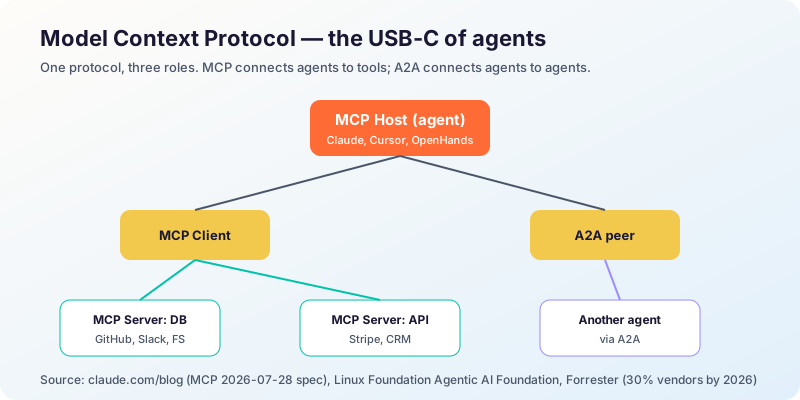
MCP vs A2A — know the difference
These get confused. MCP connects an agent to tools and data. A2A (Agent-to-Agent) connects an agent to another agent for delegation — think GPT handing off to a specialist. You need both: MCP for capability, A2A for coordination.
Security is part of the spec now
Because MCP servers can touch sensitive systems, the ecosystem shipped guardrails too: mcp-scan / agent-scan is an open-source scanner for MCP servers and agent skills. Don’t wire an untrusted server into your host without scanning it first.
At Make In India Studio we expose internal tools to our n8n agents through MCP-style connectors, gated and logged. Standards make that boring — which is exactly what you want from infrastructure.
Sources
- claude.com/blog — “Bringing MCP 2026-07-28 to Claude”
- Wikipedia — Model Context Protocol
- bidsense.co.kr — Agentic AI mainstreaming (2026)
- brightdata.com — MCP vs A2A comparison
- dev.to/snyk — agent-scan / mcp-scan